Billing & Plan
The Billing & Plan tab shows what your company has spent this cycle, how much of it was free, and how long your data is kept. It is also where the two controls that change those things live — both Owner only.
Credits
Credits are the usage currency. Two things spend them:
- Device connectivity — a device consumes 11 credits every 5 minutes while it is Online or Running. A device that is Offline consumes none.
- Alert actions that contact a person — SMS, email, and so on.
Max Credits is a kill switch, not a budget alert. When your usage reaches it, credit-consuming actions stop until the Reset Date — including device connectivity, so connected devices disconnect and stop reporting. There is no LED symptom and no network symptom; the fleet simply goes quiet. If every device goes offline at once, check this tab before you check anything else.
The free allowance
Every billing cycle includes 1,143,000 credits at no cost. Only usage beyond that is billable.
There is no limit on how many devices you register — only connectivity is metered, so a device costs nothing while it is Offline.
To work out what your own fleet needs, and what anything beyond the allowance costs, use the pricing calculator .
What’s on the tab
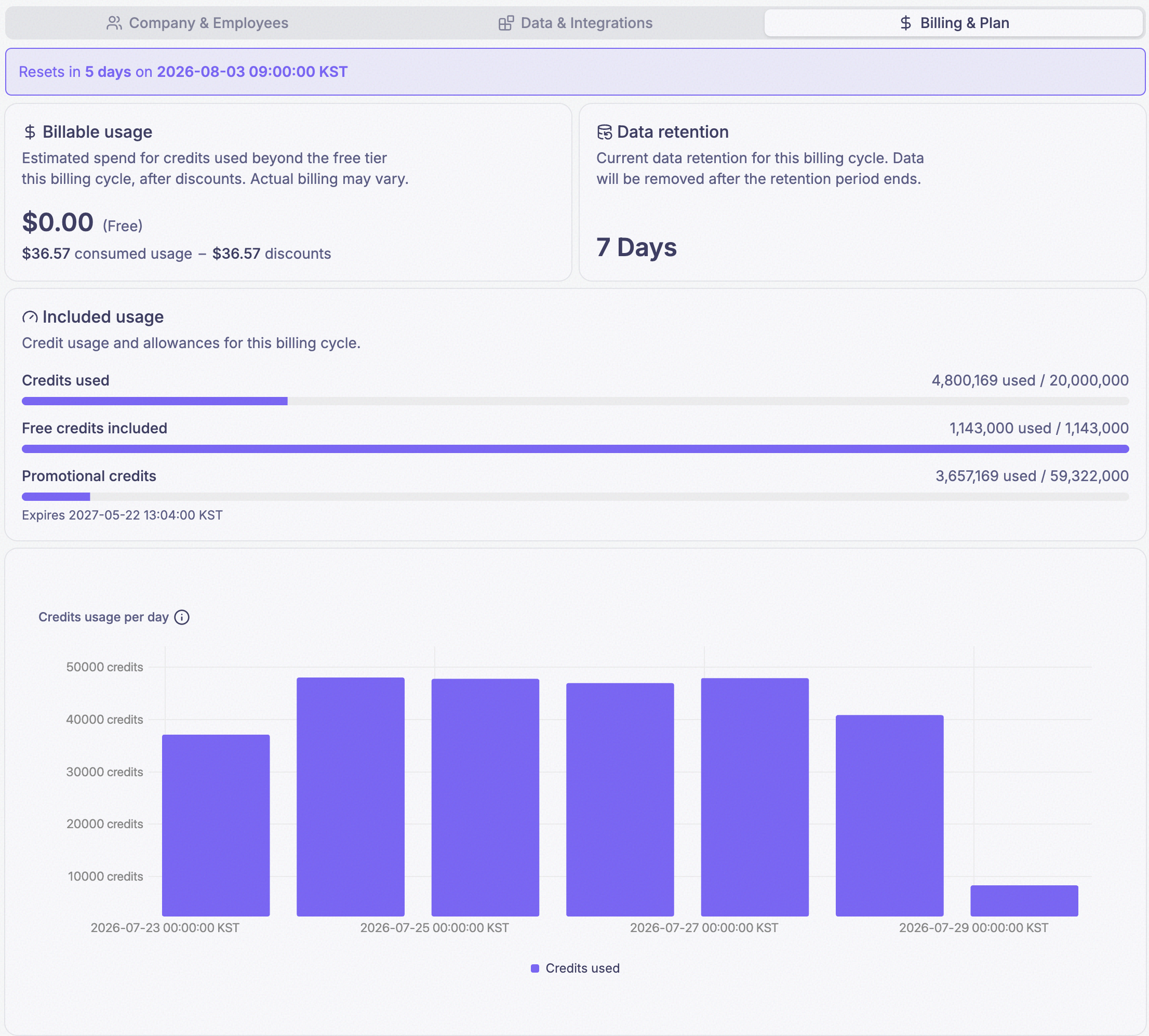
- The reset banner — how many days until your credit counter returns to zero, and the date it happens. The Reset Date advances 30 days each time it resets.
- Billable usage — an estimate of what you have spent beyond the free allowance this cycle, after any discounts. It is an estimate; the card says as much.
- Data retention — your current window. See below.
- Included usage — three meters: Credits used against your limit, Free credits included against the allowance above, and Promotional credits with their expiry date, if you have any.
- Credits usage per day — a bar chart of the last 7 days. It is a real
widget reading the
$SYS/credits/usagesystem field, so it behaves like any other chart on a dashboard.
Set Usage Limits
The Set Usage Limits button in the page header opens a dialog with two fields: Credits — your Max Credits, the kill switch above — and Retention days.
Owner only. An Admin cannot open it, which means an Admin cannot raise the limit even while the fleet is about to hit it.
Use the pricing calculator to work out what to set.
Data retention
Data retention is how long recorded field values are kept. Five windows are available: 7 days, 30 days, 90 days, 180 days, and 1 year. Change it in the Set Usage Limits dialog.
Retention is the ceiling on every way of reading data back — dashboards, webhooks, the REST API, and CSV export can none of them show a value that has expired.
Each value keeps the retention it had when it arrived, and changing the setting never revisits it. So both directions are safe and both are surprising:
- Shortening retention destroys nothing. Values recorded under a 90-day window still last 90 days.
- Lengthening retention recovers nothing. Going from 7 days to a year does not bring back last month — it applies only to values that arrive from now on.
Billing Portal
The Billing Portal button in the page header opens PRIZM’s billing provider in a new tab, where you manage your payment method, download invoices, and change your plan. Owner only.
Plan changes are made there, not in Settings.
During a proof-of-concept your tab looks different
If PRIZM set your credit limit for you — which normally happens during a proof-of-concept — the tab is reduced: there is no Billable usage card and no Billing Portal button, and Set Usage Limits changes only your retention window, with the Credits field hidden. If that describes what you are looking at, your limit is managed for you; talk to your PRIZM contact to change it.
Who can change billing
Both Set Usage Limits and Billing Portal require the Owner role. An Admin can read this tab but change nothing on it, and employees with the User role cannot reach it at all. Full table: Who can do what.